One category helps with tasks; the other protects the process
A business can become more productive without making its processes more dependable. Employees may write faster, organise tasks better and communicate more easily while customer hand-offs still fail or approvals remain unclear. That is the practical difference between productivity tools and business process tools. Productivity software improves how people perform activities. Process software coordinates a repeatable journey across people, rules and records. Choosing between them starts with deciding whether the friction sits inside an individual's work or between the stages through which work must travel.
Use productivity tools when the method can remain flexible
Writing applications, note systems, calendars, task lists and collaboration software give users ways to organise and produce work. They are particularly useful where the desired outcome matters more than a prescribed route. Two employees may organise their preparation differently and still deliver equally good results. In these situations, imposing a formal workflow can create unnecessary administration. A productivity tool earns its place by making the activity easier while leaving appropriate discretion with the person doing it.
Use process tools when sequence and hand-off matter
Some work cannot safely depend on personal preference. An enquiry may need qualification before quotation; an expense may need approval before payment; a service case may require escalation before closure. Business process tools make these stages explicit and record how work moves between them. They can assign responsibility, require information and expose exceptions. This structure is useful when several people participate or when management needs confidence that an important step was not quietly skipped.
Look for the point where personal reminders stop being enough
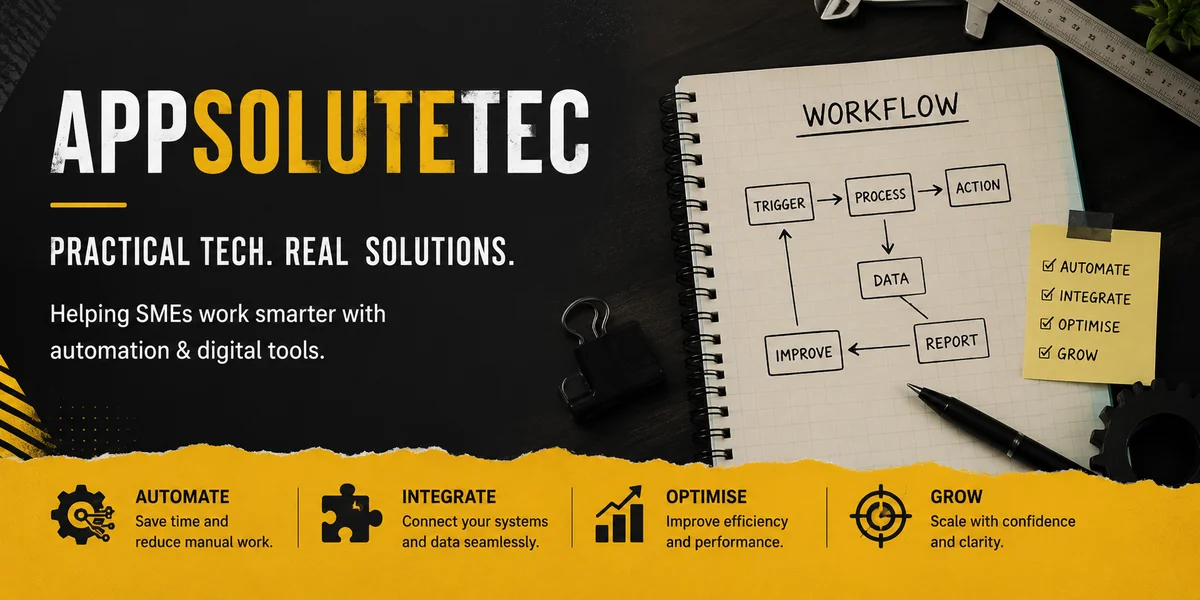
A small business can operate effectively with simple productivity tools for a long time. The warning signs appear when staff create parallel spreadsheets, repeatedly chase colleagues, search conversations for decisions or rely on one experienced person to explain the current state. These are coordination problems. Adding another personal task app rarely fixes them because the missing element is a shared process. Map the work from trigger to completion and identify where responsibility, evidence or status becomes ambiguous.
Do not automate a process nobody has agreed
Business process platforms often include rules and automation, but configuring them too early can freeze accidental habits into software. First agree what should happen, where exceptions occur and who has authority to decide. Then automate stable transitions and repetitive administration. A useful workflow reflects the real operation closely enough that employees do not need a hidden second process outside the system. When people routinely bypass a workflow, investigate whether the design is wrong before assuming the users need more training.
Allow the two tool types to complement each other
A structured process can create a task that appears in an employee's preferred working view. A document can be drafted in a collaborative productivity suite before its approved version is attached to the formal business record. This combination provides flexibility without sacrificing accountability. Establish which system owns each important fact and avoid duplicating statuses between applications. Integration should let information cross a deliberate boundary, not create several places where the same process appears to be managed.
Assess reporting according to the question being asked
Productivity reporting often describes activity: tasks completed, time allocated or documents produced. Process reporting should reveal the state and movement of work: where items wait, which hand-offs fail and what remains unresolved. Neither is inherently more valuable. The correct view depends on the decision. A manager trying to understand why customer onboarding stalls needs process evidence, while an employee planning today's workload may need a simple personal task view.
Test one real hand-off before buying a heavier platform
A practical comparison can be made with a recurring piece of work that crosses at least two roles. Take a customer enquiry that needs an initial response, an internal decision and a final follow-up. Run it first through the current productivity tools and note where somebody has to remember a transfer, copy information or ask for status. Then model the same journey in the proposed process tool. The stronger option should make ownership and exceptions clearer without adding unnecessary data entry at every stage. If the only improvement is a more elaborate task list, the business may not need process software yet. If the test removes repeated chasing and makes the current state understandable without asking several people, the additional structure is solving a genuine coordination problem.
Buy the least structure that keeps the work reliable
More formal software is not automatically more mature. Excessive workflow can slow a small team and make ordinary changes difficult. Equally, excessive flexibility can hide responsibilities once the business becomes busier. Choose productivity tools where people need freedom to organise an activity and business process tools where the organisation needs a repeatable, visible route from trigger to outcome. The best software environment often contains both, connected by clear ownership of information. That keeps individual work practical while ensuring important business processes do not depend on memory.