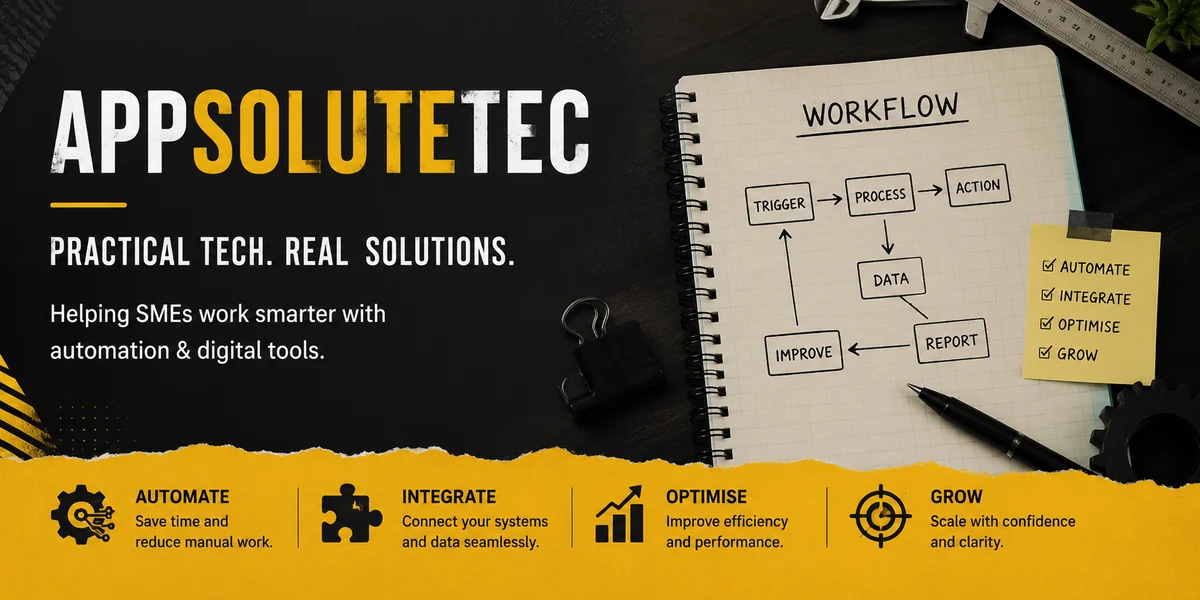
Property businesses rarely suffer from a shortage of software. The more common problem is that the important information is scattered: enquiries arrive through one route, property records sit somewhere else, documents are passed by email, viewings and updates are logged inconsistently, and reporting depends on people knowing which spreadsheet or system is closest to the truth. The friction appears between the tools rather than inside any one of them.
Servadra Solutions focuses on custom software and business systems built around real operating requirements. Its current public proposition covers web applications, mobile apps, backend services, databases, customer portals, workflow automation, integrations, reporting, deployment and support. For estate agencies and property SMEs, the useful part of that proposition is the ability to think about the complete workflow instead of treating every digital need as a separate purchase.
Property workflows are a chain, not a collection of screens
A property transaction or management process involves a sequence of people, records and decisions. An enquiry becomes a contact; a contact may become a viewing; a viewing creates follow-up; documents are requested; status changes need to be recorded; and different teams may need access to different parts of the same record. If those stages are split across disconnected systems, the business carries the integration work manually.
That is why a system project should start by mapping the chain. Which event starts the process? Which data should be captured once? Who is responsible for each next action? What information must be visible to staff, clients or partners? Servadra’s business-requirement-first approach is relevant because it treats those questions as design inputs rather than assuming that the answer is simply another app.
Customer portals can improve visibility without replacing personal service
Servadra lists customer portals among its current public capabilities. In property, a portal can be useful where clients or applicants repeatedly need access to status, documents, appointments, requests or agreed information. The aim should not be to remove human contact. It should be to remove avoidable uncertainty.
A well-designed portal can show the user what has happened, what is needed next and where important documents or messages belong. That is particularly useful in processes where customers otherwise send repeated “what happens now?” emails. The portal should expose only the information appropriate to the user and should be designed around the actual journey rather than around the internal database structure.
Mobile workflows matter when work happens away from the desk
Property teams often work across branches, viewings, inspections, client visits and other locations. Servadra’s public capability set includes mobile applications as part of complete systems, not simply as standalone consumer apps. That distinction matters when a mobile interface needs to connect directly to operational records and backend workflows.
A useful mobile workflow might support structured capture, photographs, checklists, status updates or document generation where appropriate. The design should consider connectivity, permissions and what happens if a field action cannot synchronise immediately. The point is not to move every desktop screen onto a phone. It is to identify the tasks that genuinely benefit from being completed at the point of work.
Document-heavy processes benefit from structured data
Property businesses handle a large volume of documents and recurring information. Problems arise when the same names, addresses, dates or status details are copied repeatedly between forms, emails and systems. A joined business system can reduce that duplication by using structured records as the source for later documents or workflow actions.
Servadra’s public material includes database work and document-generation capability among its wider system patterns. The practical value is consistency. If the correct property, customer and transaction details already exist in the system, later outputs should be produced from controlled data rather than manually retyped wherever possible. That can reduce simple administrative errors and make changes easier to trace.
Integration should protect useful existing systems
Custom software does not need to replace every platform already in use. Servadra explicitly positions integration with existing systems and APIs as part of its work. For property SMEs, that matters because specialist tools may already handle important functions well. The real problem may be that staff must re-enter data or manually transfer status between them.
An integration plan should establish which system is authoritative for each type of record and what information genuinely needs to move. Not every field needs to be synchronised. The goal is to remove unnecessary re-entry while keeping responsibility clear. If two systems can both modify the same critical record without rules, integration can create confusion rather than reduce it.
Reporting is only as good as the workflow beneath it
Property managers and agency owners often want a clearer operational picture: outstanding actions, enquiry status, workload, pipeline stages or service activity. Servadra includes reporting and dashboards in its stated capability set, but the quality of any dashboard depends on how consistently the workflow records those events.
The strongest projects therefore define meaningful statuses and required data before designing charts. A dashboard should answer an operational question, not simply display whatever the database happens to contain. When the underlying process is structured, reporting can reduce the need for manual weekly reconciliation and make exceptions easier to see.
A full-system delivery model can simplify responsibility
Servadra’s current delivery sequence is Understand, Define, Design, Build, Verify, Launch and Support. In a property workflow project, those stages create useful checkpoints. Understanding maps the current journey. Definition agrees scope and users. Design establishes data, permissions and integrations. Build implements the agreed system rather than discovering the requirements by accident.
Verification should include real operational scenarios: changed appointments, incomplete records, duplicate contacts, permission boundaries and failed integrations where relevant. Launch should follow agreed acceptance, and support should recognise that property processes evolve over time. A joined system needs controlled change after the first release just as much as it needs a careful initial build.
When bespoke software is proportionate for a property business
Most property firms should not commission custom software simply because an existing product has an annoying screen. Standard platforms are often the better answer for standard needs. Bespoke work becomes more defensible where the business has a distinctive workflow, meaningful integration requirements, repeated manual re-entry, customer journeys that existing products cannot support, or operational reporting that depends on joining several sources.
AppSoluteTec readers assessing that position can review Servadra’s What We Build overview and compare the full-system model with their current property workflow. The best starting point is not a feature wishlist. It is a clear map of where information is duplicated, where customers lose visibility and where staff are acting as the integration layer between systems.