Artificial intelligence adoption in UK businesses is rising quickly, but adoption is not the same thing as integration. That distinction matters for small firms because it separates experimenting with an AI tool from actually redesigning a workflow around it.
Official 2026 evidence shows both sides of the picture. The Office for National Statistics reports that self-reported AI use among UK businesses with 10 or more employees increased from around 12% in late 2023 to around 35% by 2026. Yet the same analysis describes adoption as relatively shallow: the average number of AI technologies used by adopting businesses increased only modestly, from around 1.4 to around 1.6.
The UK Business Data Survey adds another layer. Among businesses handling digitised data, 41% said they used AI for at least one purpose in 2025 to 2026. But among AI-using businesses, only 21% said their tools were integrated into existing business systems. That gap between use and integration is one of the most useful signals for small-business decision-makers. It suggests that AI is spreading faster than it is becoming part of core operating systems.
Using an AI tool is not the same as changing a workflow
Many businesses begin with low-friction use cases. The UK Business Data Survey found that the most common reported uses included researching information and summarising or drafting in-house information, reports or correspondence. These tasks are easy to try because they can sit alongside existing processes without major technical work.
That can still be valuable. A member of staff may save time summarising a document, preparing a first draft or gathering background information. But the underlying workflow may remain unchanged: the same files, approvals, handovers and systems are still in place.
Integration goes further. The survey describes integrated use as AI embedded in existing systems such as Microsoft 365, CRM, finance software, workflow platforms or productivity tools. Once AI becomes part of those systems, it can interact with structured records, triggers, permissions and repeatable processes rather than depending on a person opening a standalone tool and pasting information into it.
That difference is important because the operational risks change as well. A standalone drafting tool may create quality-control issues. An integrated tool may also affect customer data, permissions, audit trails and downstream actions. Deeper use can create more value, but it also demands clearer governance.
Small firms appear to face a much larger integration gap
The UK Business Data Survey found substantial differences by business size. Among AI-using businesses, 57% of large businesses reported that AI tools were integrated into existing systems. The comparable figure was 31% for medium businesses, 31% for small businesses, 27% for micro businesses and 18% for sole traders.
Those figures do not prove that smaller firms are less innovative. They may reflect differences in resources, existing software, internal technical capability and the complexity of integrating systems. A sole trader can obtain value from a standalone assistant without needing a formal integration project. A larger organisation may already have enterprise systems into which AI features can be embedded.
For a small business, the right goal is therefore not “integrate everything”. It is to identify the processes where integration would remove repeated manual work or improve consistency enough to justify the added complexity.
A useful example is customer enquiries. If staff repeatedly copy information from email into a CRM, classify the request, assign an owner and prepare a standard acknowledgement, there may be a real workflow opportunity. If AI is only used occasionally to rewrite an email, deep integration may add cost without solving a meaningful problem.
More mature data practices appear alongside deeper AI use
The UK Business Data Survey also found an association between AI use and more developed data practices. Businesses using AI were more likely to report collecting, analysing and sharing data than businesses that did not use AI.
The relationship became stronger when the survey looked at integration. Among businesses whose AI tools were integrated into existing systems, 62% said they analysed data and 55% said they collected data. Among businesses without integrated AI, the comparable figures were 30% and 37%.
This is an association, not proof that integration caused better data practices. The direction may also run the other way: businesses with stronger data foundations may find it easier to integrate AI successfully.
For small firms, that is still a useful planning lesson. An AI project that depends on customer, product or operational data will only be as useful as the information available to it. Duplicate records, unclear ownership, inconsistent naming and weak permissions can limit the value of automation before the AI model itself becomes the main issue.
This is why data preparation should be treated as part of an AI project rather than an unrelated housekeeping exercise.
Integration should follow a business problem, not a technology target
The temptation with fast-moving technology is to set the wrong objective. “We need more AI integration” sounds ambitious but does not explain what the business should improve.
A stronger approach starts with a measurable process problem. Examples include slow enquiry response, repeated manual data entry, inconsistent document preparation, missed follow-ups or duplicated reporting work. The business can then assess whether AI, conventional automation or a simpler software configuration is the right response.
This matters because not every process needs AI. A deterministic rule, template or workflow may be more reliable for predictable tasks. AI is more useful where language, classification, summarisation or variable inputs make conventional rules cumbersome.
Small businesses should also consider the cost of integration. Connecting AI to core systems can introduce configuration, permissions, testing, staff training and monitoring requirements. The deeper the connection, the more important it becomes to understand what data the tool can access and what actions it can take.
Integration should therefore be earned by a clear use case rather than treated as a maturity badge.
The next phase of adoption is about depth, not just prevalence
The UK AI story in 2026 is no longer simply about whether businesses have tried AI. ONS data shows adoption rising sharply, while the UK Business Data Survey shows that use is common enough to be visible across business sizes. The more interesting question is how deeply that use changes the way work is done.
For many smaller businesses, the sensible path will be incremental. Start with one process, define the current steps, identify the specific friction, test the tool in a controlled way and measure the result. If the value is repeatable, integration can follow.
That approach avoids two common mistakes. The first is assuming that casual AI use equals digital transformation. The second is assuming that deeper integration is automatically better. Both can lead to technology being measured by presence rather than by business outcome.
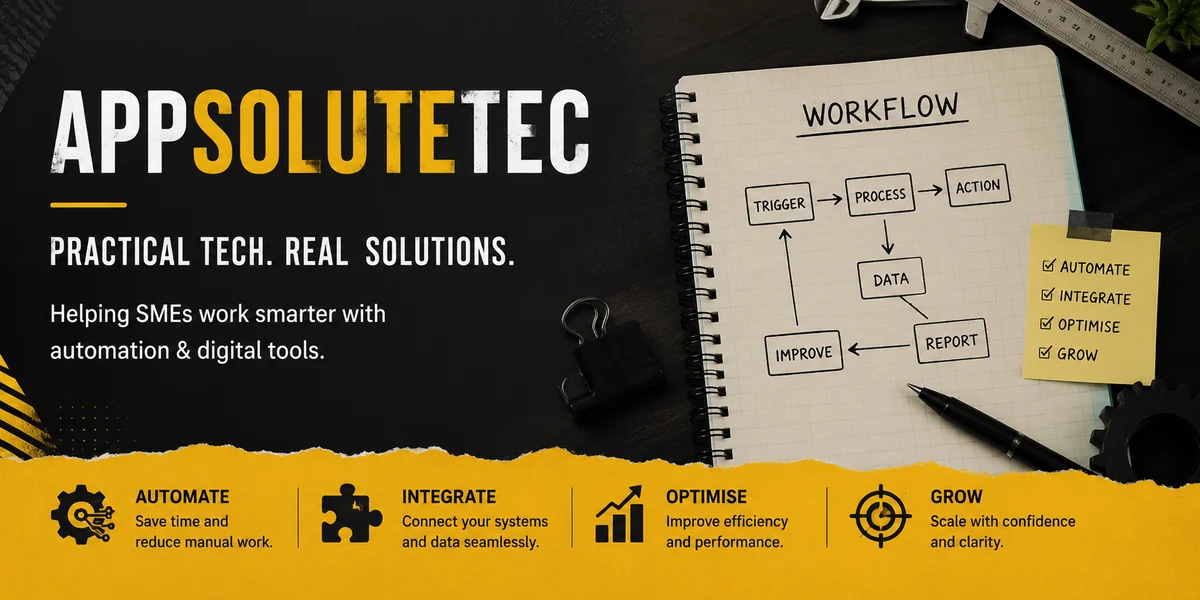
The strongest signal in the 2026 evidence is the gap itself: AI use is spreading faster than system integration. For AppSoluteTec readers, that gap is where the practical work begins.
Sources: Office for National Statistics, Artificial intelligence in UK businesses: 2023 to 2026; Department for Science, Innovation and Technology, UK Business Data Survey 2026. The two sources use different populations and definitions, so their percentages should not be merged into a single adoption rate.